APIs, explained with a burger
The word sounds scary. The thing itself is a waiter.

Let’s learn AI without the nerd stuff. Day 3. Today, we talk about APIs.
I know. The word alone makes people’s eyes glaze over. Application Programming Interface. Sounds like something only engineers are allowed to understand.
It’s not. You already understand it. You just don’t know you do yet.
Here’s the whole thing, in one scene.
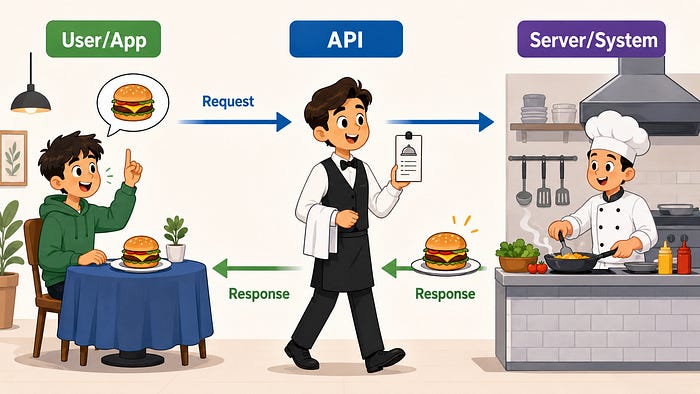
You walk into a restaurant. You tell the waiter you want a burger. The waiter doesn’t cook it. The waiter walks your order to the kitchen, hands it to the chef, waits, and brings the finished burger back to your table.
You never talked to the chef. You didn’t need to. The waiter handled the whole exchange.
That waiter is an API.
Now put that in your phone.
Say you open your weather app to check Chennai before you leave the house. The app doesn’t know the weather. It has no idea what’s happening in the sky over Chennai right now.
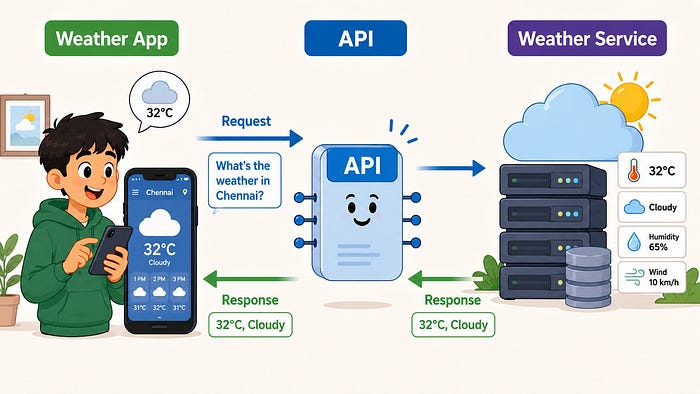
So it sends a request, through an API, to a weather service, maybe Google Weather, maybe some other provider working quietly in the background. That service checks its data, sends the answer back through the same API, and your app displays “32°C, humid, don’t bother with the jacket.”
You saw a temperature. What actually happened is your app asked a stranger a question and got a straight answer back, fast enough that it felt instant.
One app, many waiters.
This is where it gets useful to understand, not just cute.
Open Swiggy or Uber Eats to order dinner. That single app is running several of these API conversations at once. One API checks your delivery address against maps. Another one processes your payment. Another confirms your login. If something goes wrong and you open a support chat, that’s routed through an API too, sometimes straight to an AI system on the other end.
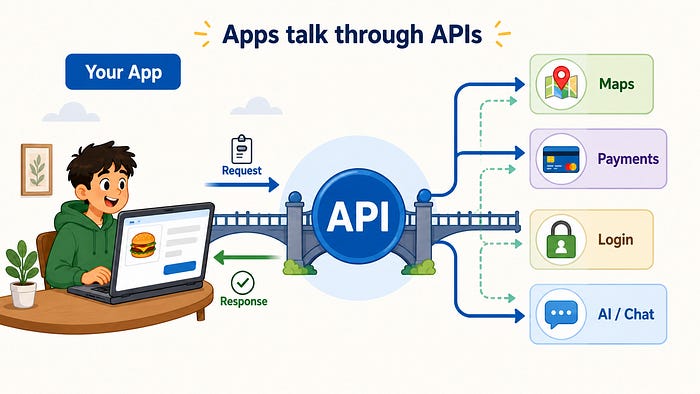
None of these systems talk to each other directly. They all go through the API, get their answer, and hand it back to the app you’re staring at. You just see one clean screen. Behind it, a small army of waiters is running back and forth to a small army of kitchens.
That’s the whole concept. A messenger that lets one piece of software ask another piece of software a question and bring back the answer, without either one needing to know how the other actually works.
You don’t need to know how the kitchen makes the burger. You just need someone to bring it to your table.
Got a topic you want explained without the nerd stuff? Drop it in the comments and I’ll cover it. I’m teaching a million people AI by the end of 2026. If you’re reading this in July, you’ve got until December to become genuinely good at this.
See you tomorrow.
Get the full AI Vocabulary
AI for Non-IT Library | The Arthi AI Collective